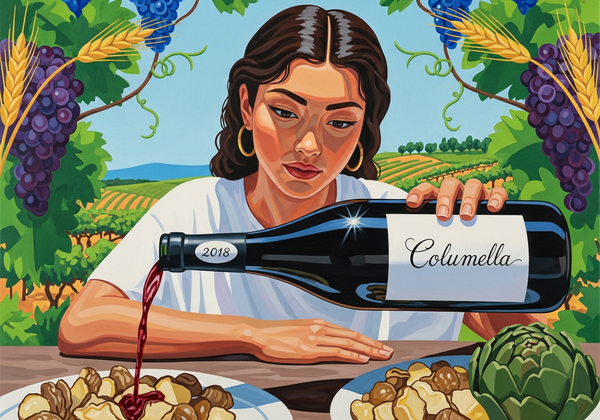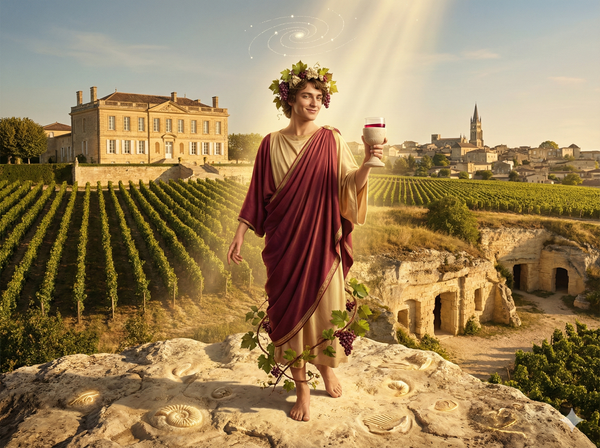
Bacchus freezes a Margaux gale mid-scream to prove that only split-second timing can turn Château Palmer 2018 from portfolio peril into perfumed profit.


Bacchus recounts the night he corked a gale above Margaux - and why that split-second gamble mirrors the precise timing Palmer 2018 now demands of serious investors.
When Bacchus bottled the breeze
A feral mistral once shot up the Gironde, ready to rip every violet blossom from Palmer’s Cabernet vines. I shinnied up the tallest riverside oak, snapped a limb thick as a sailor’s mast, and drove it into the heavens like a stopper. The wind ricocheted, reversed, then swept backward in a shimmering wave; petals drifted over the vineyard like purple snow. I gave the château one hour to gather every blossom-kissed cluster before the cork would burn to ash and the gale returned with double fury. The nimble filled their baskets with perfumed fruit. The laggards harvested nothing but battered stems. Timing, not muscle, decided who profited from that tempest - the very dilemma Château Palmer 2018 now poses in the marketplace.
Perfume in the glass, heat on the screen
Palmer 2018 hails from a Left-Bank vintage lauded for concentrated fruit and long life. The blend is an almost equal dance of Cabernet Sauvignon and Merlot, underpinned by a dash of Petit Verdot, and critics expect it to cruise comfortably from 2025 to well beyond 2045. Biodynamic farming across fifty-five prime hectares adds supply discipline, while Liv-ex quotes a globally tracked price of about $576 a case. On paper, everything about the wine screams blue-chip Margaux.
Performance, however, has been less divine. Since November 2020 the compound annual return is a wafer-thin 0.07 percent, even as volatility rattles in at a nerve-shredding 143 percent. During the pandemic trough the price plunged almost forty-eight percent, and although short-term modelling projects a bounce to roughly $603 within six months, one-year outlooks sag back toward $550. Auction rooms echo that ambivalence: a recent six-pack in Hong Kong merely scraped its reserve, while a London case failed to meet the hammer and later traded privately at a small discount.
Reading the Margaux weather vane
When set beside its own lineage, the disconnect sharpens. The 2015 vintage hovers near $610 after a gentle multiyear rise and carries barely half the risk. The 2016 trades closer to $650 and enjoys deeper bid books. Over in Saint-Émilion, Canon 2018 has delivered a steady six-percent CAGR without the roller-coaster chart. In pure sensory terms, Palmer 2018 sits shoulder-to-shoulder with those wines; in risk-adjusted performance it trails, and every gust of market sentiment hits it harder.
Strategy from the god of wine
Collectors driven by quality might lay ambush bids around the $540-to-$560 range, lock the cases in flawlessly ventilated 55°F storage, and glance again in a decade. If critical scores continue to climb and unsold stock dries up, today’s flat line could arch into that blossom-perfume premium. Investors hunting shorter-cycle gains should demand clearer skies: three consecutive quarterly upticks or a decisive Liv-ex print above $600 with volume. Anything less, and the mistral could still whip capital away faster than a torn blossom.
Petals or Stems: The Split-Second Verdict
I left Margaux that dawn with petals in my hair and the memory of a vineyard saved by a single heartbeat. Harvest too early, you waste fragrance; too late, you salvage nothing but stems. Palmer 2018 is the same: seize it at the right moment and the wind may perfume your ledger - hesitate and it might shred the page.