1985 Bolgheri: Sea Wind That Forged Italy’s Quiet Revolution
Bolgheri 1985: A defining vintage where Sea Wind and Cabernet merged, forging Italy's modern elegance. Sassicaia 1985 set the template: structure, salt-borne grace, and monumental aging potential. Essential history for collectors.

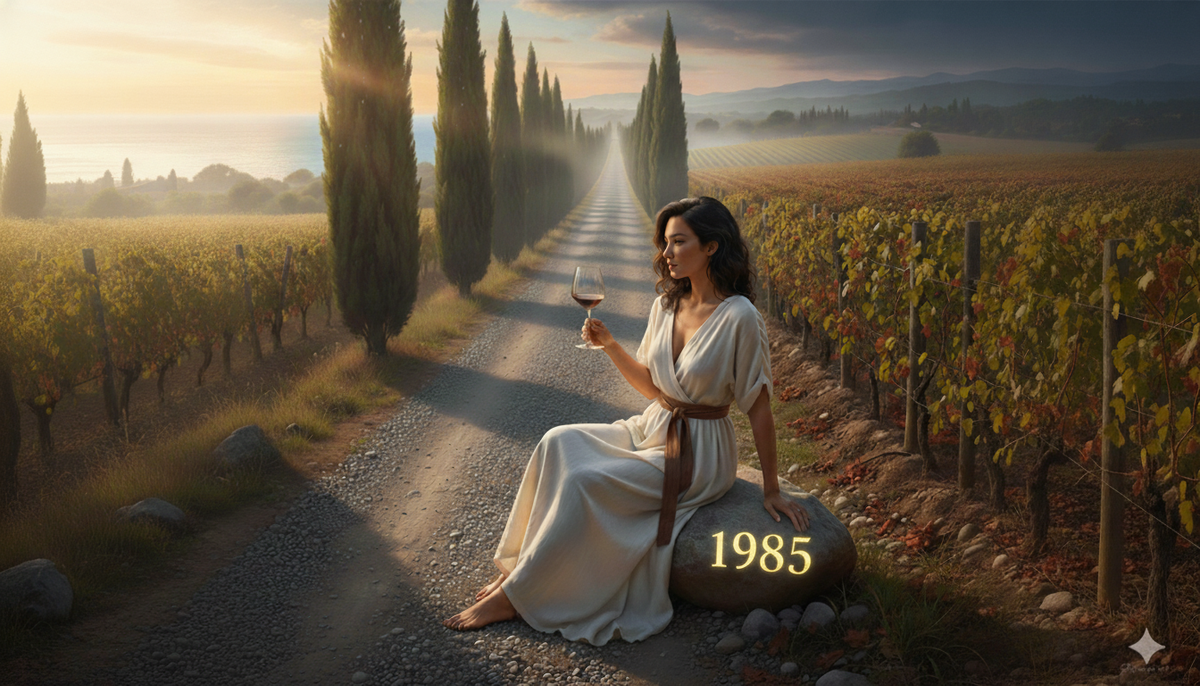
Blackcurrant and thyme riding a salt wind—can a place discover its true self in a single, luminous harvest?
The Season's Quiet Alchemy: Maritime Calm and Coastal Sun
The Bolgheri 1985 vintage benefited from a rare tranquility. The year began with an extremely cold winter inland, with the coast (Bolgheri) less affected, leading into a warm, luminous spring. The summer was long and dry, pushing the Cabernet Sauvignon and Cabernet Franc toward perfect ripeness, yet never tipping into excess heat. Crucially, the vines were continuously tempered by the cool, saline maritime breezes rolling off the nearby Tyrrhenian Sea. This diurnal calm, coupled with the rapid drainage of the gravelly alluvial soils, perfectly aligned ripening with structural restraint. This era, of course, was before Bolgheri reds had DOC recognition (the Bolgheri DOC existed from 1983 for white/rosato; reds were added in 1994; Sassicaia received its own DOC in 2013)—a time of quiet, radical experimentation. They harvested without fanfare, not realizing they had captured a coastline in liquid form.
The Structure's Pledge: Salt-Borne Grace and Enduring Form
Is 1985 Bolgheri worth aging? Absolutely, unequivocally yes. This vintage is not merely good; it is the defining moment for modern Italian wine. 1985 Sassicaia earned 100 points from Robert Parker and is widely cited as a watershed year for Super-Tuscans. The spectacular success of Sassicaia 1985 (sold as Vino da Tavola, later gaining the dedicated Bolgheri Sassicaia DOC) transformed a coastal experiment into a national, then global, awakening. The vintage perfectly married ripeness and restraint, structural depth and sea-light precision, creating a template for all Cabernets that followed in Italy. It marked the profound shift from perceived Tuscan rusticity to refined, salt-borne grace.
Decoding the Glass: Ink, Salt, and the Horizon's Edge
To taste 1985 now is to touch the deep, mineral memory of the Tuscan coast. The sensory core revolves around dense blackcurrant, wild plum, and classic cedar, layered with dried bay leaf, iron, tobacco, and cold graphite. The mouthfeel beautifully balances warmth and maritime precision: a sleek, immediate entry gives way to fine-grained tannins that define the mid-palate, concluding with a distinct saline finish that lingers like dusk on wet stone. The entire experience is a horizon drawn in ink and salt. Cabernet straightened its posture here, learned to breathe slower, closer to the sea. Its freshness, decades later, is genuinely astonishing. I can still smell the salt in that vintage's finish, a memory of the sea wind carrying the bay leaves.
The Landscape Speaks: Gravel, Maremma, and the Tyrrhenian Sigh
Bolgheri’s setting in the Maremma is the key to its genius. The landscape is a geological paradox: low, gentle hills with varied marine and alluvial soils (sand, clay, gravel), running directly to the Tyrrhenian Sea. Maritime breezes from the Tyrrhenian moderate temperatures; soils are marine and alluvial, with gravelly areas. The 1985 vintage definitively established the region’s identity as producing wines of Atlantic-like structure—cool, linear, and balanced—but retaining a distinctively warm, Mediterranean soul. The foundational vineyards of the time—Tenuta San Guido (Sassicaia), and other early plantings—proved that the local gravel remembers the sea, and 1985 was the year it learned to speak.
Style Spectrum: The Patient Hand and the French Oak Cradle
The structure of 1985 was not accidental; it was the result of pioneering precision. The work began with hand-harvested fruit and was refined by meticulous extraction. Aged 22 months in barrique; in 1985 Sassicaia used both French and Slavonian oak (major share French) with a high proportion of new wood. The vintage's inherent balance—its natural harmony of ripeness, fine tannin, and cool acidity—allowed for this long élevage without any risk of heaviness or oxidation. The wine was the proof: 1985 marked the first moment that Bolgheri Cabernets matched Bordeaux’s poise while keeping a distinctly Tuscan, iron-tinged soul. The technical choices were minimal, yet monumental. You can still taste the sea wind caught in its oak.
Producers & Legacy: Whispers Turned to Canon
The narrative of best producers Bolgheri 1985 is essentially the dawn of modern greatness. Tenuta San Guido (Sassicaia) is the icon that set the world’s perception alight, delivering a wine of sublime density and elegance. While Sassicaia became the immediate legend, the quiet consistency shown by Grattamacco and the first Ornellaia (first vintage 1985) showed the terroir’s breadth alongside Sassicaia. Giacomo Tachis consulted on Sassicaia and helped refine its modern style, providing the wisdom and patience necessary to refine Bolgheri’s modern voice from a simple experiment into an established structural signature. Fame came overnight, but the vineyards had been whispering this truth for years.
Drink-or-Hold Scorecard
The 1985 vintage is a testament to structure, requiring reverence and careful handling today.
- Early Glow (now–2030): Remaining bottles of Sassicaia and early Grattamacco remain luminous, speaking of their youth with clarity. Decant gently and quickly, as the sea breeze fades if left too long in the glass.
- Sweet Spot (2031–2040): This is the window of mature grace: dried fruit, cedar, graphite, balsam, and a profound maritime hush dominate the profile. The wine is fully resolved but still vibrant.
- Marathon (2041+): Peak depends on storage; top bottles remain superb now, but most are at or near apex—decant gently and drink on the shorter side of the next decade. The acidity and salt spine ensure quiet endurance.
Final Reflection
The 1985 Bolgheri vintage captured the pure essence of sunlight and salt on gravel, defining a new era for Italian winemaking. It achieved a sublime balance of Atlantic structure and Tuscan power, thanks to the cool maritime air and perfect ripeness. This singular moment of clarity became the template for modern Italian elegance. Ultimately, 1985 is a vintage that remains poised and profound in the quiet hush between sea wind and stone.