Ironstone Psalms and the Long Descent: Penfolds Grange 2018
Penfolds Grange 2018 food pairing guide with distinctive plant-forward dishes, decanting insight, and mythic perspective on Australia’s icon.

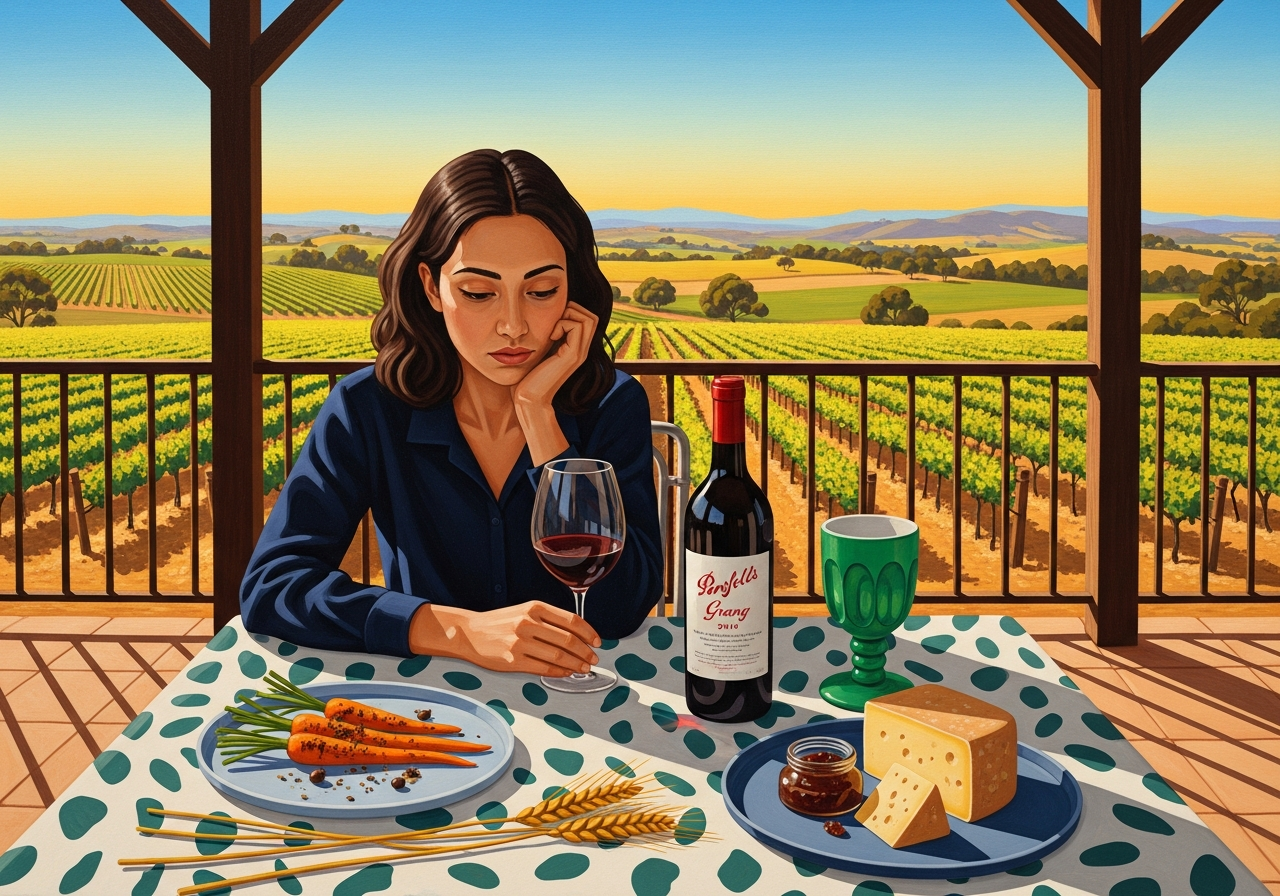
I pour Grange as I once poured libations at the edge of the steppe, when the vine still had a goddess and time still obeyed the moon. Slowly, deliberately. The wine unfurls into the glass like dark ink meeting clay: opaque at the core, violet-black at the rim, light swallowed rather than reflected. This is not a wine for haste. It asks for an hour in a wide decanter so the iron, graphite, and balsamic shadows can loosen their grip, and it shows best around 18 °C, when warmth animates without blurring. I choose a tall Bordeaux stem—not for ceremony, but for truth—so its voice can rise without crowding itself.
Where this wine is born, and what it remembers
Penfolds Grange 2018 comes from Australia, from South Australia’s most resonant Shiraz vineyards—Barossa, McLaren Vale, and their neighbouring voices—guided by Penfolds’ long, continuous custodianship rather than a single auteur hand. Shiraz forms the spine, with a trace of Cabernet Sauvignon when the season calls for structure. The farming is not biodynamic; it is pragmatic, increasingly sustainability-minded, attentive to soils and water in warm Mediterranean conditions. These are ironstone and ancient seabed soils, heat-retentive by day, cooling slowly at night, imprinting the wine with density, savour, and a distinctly terrestrial gravity.
The character beneath the legend
Grange arrives already mythologised, its name spoken before its substance. I prefer to meet it as I meet dreams: without interruption. On the nose, it moves in layers—mulberry skin, black plum, and cassis first, then violet, clove, and cedar, and finally a mineral coolness that recalls wet stone after summer rain. The oak is present but disciplined, lending spice and shadow rather than sweetness. On the palate, the structure asserts itself. Tannin—felt as a firm, drying clasp along the gums—is abundant but finely woven, carried by a line of acidity that keeps the wine upright and awake. The finish is long, savoury, and deliberate, like a sentence that knows exactly where it will end.
The 2018 season was warm yet balanced, and the wine holds that tension with poise. There is power here, unmistakably, but also restraint. Grange is often called monumental; I find it ritualistic. Each element serves a function, each measure earned. Decanted now, it is vivid and commanding; cellared, it will relax into something deeper and more fluent through the 2030s and well beyond.
I am Geshtinanna—Heavenly Vine, keeper of ledgers and laments—and I know that vitality in wine is not only born of biodynamic calendars or buried horns. It is born of listening. This wine listens to its sites, and time listens back.
Bitter roots, smoke, and the work of tannin
When tannin arrives with this kind of authority, I turn away from the obvious and toward bitterness, smoke, and slow sweetness. Think of radicchio wedges grilled until their edges char and their bitterness mellows, finished with walnut oil and shavings of an aged alpine cheese. The bitterness steadies the fruit, the fat cushions the tannin, and the smoke echoes the wine’s own dark register. Or imagine Jerusalem artichokes roasted until caramelised, folded into a purée with browned butter and a whisper of nutmeg; their earthy sweetness meets the Shiraz fruit without softening its resolve.
Fermentation, umami, and the long middle passage
Grange thrives alongside dishes that understand time and transformation. I have poured it with a miso-braised aubergine—white miso, slow heat, finished with sesame oil—where fermentation meets fermentation. The key is fat and sweetness: without them, umami sharpens tannin; with them, it deepens savour. Another companion I trust is a farro risotto enriched with mushroom stock and finished with cultured butter. The grain’s chew mirrors the wine’s architecture, while the mushrooms speak directly to its savoury core.
Heat, sweetness, and the Australian sun
There is room here for restrained warmth. A pumpkin baked whole until collapsing, glazed with maple and native pepperberry, finds harmony with the wine’s ripeness and spice without tipping into sweetness. The acidity keeps the pairing buoyant; the spice threads itself into the oak. This is how warm-climate wines ask to be met: not cooled into silence, but balanced into clarity.
One memory of flesh, no more
In the lands that shaped this wine, lamb is an ancestral shorthand. If it appears, let it appear only as memory—a spoon of rosemary-scented jus, nothing else. Grange does not require flesh; it requires depth.
Closing the circle
As the table quiets, I favour endings that do not sweeten the story. A slab of aged clothbound cheddar with quince paste, or roasted carrots finished with black treacle and cracked coriander seed, carry the wine to its final cadence. These are offerings, not courses.
Grange 2018 is a wine of patience and descent. Give it air, give it a proper vessel, and give it food that understands bitterness, fermentation, and time. I have spent half my existence below the earth, recording names and seasons, and half returning to light. Wines like this recognise the cycle. They are forceful now, wiser later, and always clearer when met with intention.