Napa Valley 1978 — The Autumn That Taught Power to Wait
Napa Valley 1978 is a legendary Cabernet vintage defined by cool-climate elegance. Mountain Shadow and high acidity forged structural integrity and patience, proving true California power moves with grace. Essential guide for collectors.

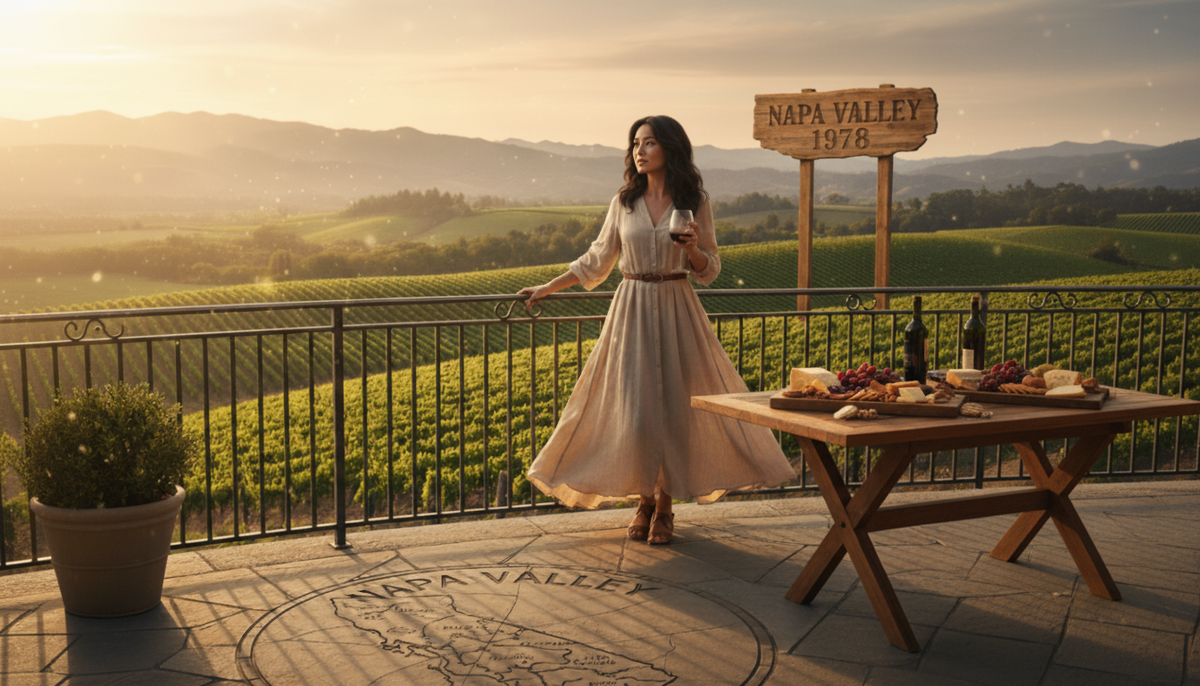
Blackcurrant and bay leaf under a cool October sun—can patience truly taste this alive, or is that just the echo of memory?
The Season's Quiet Alchemy: Cool Nights and the Slow Turn
The Napa Valley 1978 vintage unfolded with the slow, deliberate grace of an earlier era. A cool, wet winter built deep reserves, setting up a late, slow spring. The summer was long and mild, allowing the Cabernet Sauvignon to ripen fully and evenly without stress. However, the period was not uniformly cool; the even season was challenged by a pre-harvest heat spike that made picking frantic in many areas. While some valley floors pushed riper, cooler sites like Stags Leap District retained a vivid, linear acid line. Winemakers were already adopting new ambitions, but 1978 demanded a pause—old-school patience met emerging ambition. Generally, the season delivered a powerful structure; they didn’t know they were bottling a generation’s turning point.
The Structure's Pledge: Discipline That Outlived the Decades
Is 1978 Napa worth aging? Unequivocally yes. This vintage is a profound marker in Napa’s history: it stands as one of the first post-Judgment vintages to prove Napa’s long-term classicism, blending European restraint with California sunlight. It is remembered as a year where firm tannin, vivid acid, and moderate alcohol (approx 12–13%) created a tension that outlived louder, riper decades. Top bottles from this period are still stunningly eloquent today. Its discipline—its structural integrity—is why the best bottles remain luminous and articulate.
Decoding the Glass: The Craftsman's Steady Hand
To encounter 1978 now is to feel the air thin and the mountain stand still. What remains is a pure, centered essence: blackcurrant, dried red plum, and the dusty savor of dried sage, framed by graphite, classic cedar, tobacco leaf, and dusty cocoa. The texture is cool and firm at the core, the once-powerful tannins now resolved to a silk-fine persistence. The acidity carries the structure, moving through the palate like autumn wind through dry grass. The finish is long, mineral, and gracefully austere. This quiet endurance is a mountain’s heartbeat slowed to stillness. Cabernet sits here like an old craftsman, quiet hands still steady, work unfinished. I can still feel the cool harvest air in that glass, decades later—its freshness astonishing.
Regional Snapshot: The Mountain's Shadow and the Valley's Heart
The 1978 vintage speaks in distinct geographic dialects. Rutherford established its benchmark balance: cool cassis fruit, crystalline cedar, and the signature fine, dusty tannin. Oakville provided ripeness but retained an elegant, polished structure thanks to the valley's diurnal swing. Stags Leap District delivered wines with a floral lift, iron backbone, and the precise tension of violet and graphite—a cool-edge success that year. Spring Mountain produced dense, earthy expressions with deep mountain-shadow tannins, destined for long arcs. Even Calistoga, with its heat-etched depth, was tempered by the cool nights, achieving balance. The dark horse of 1978 was the older hillside vineyards, often dry-farmed, whose fruit gave quiet power and tension without excess alcohol, capturing the essence of the unhurried season.
Style Spectrum: Waiting for Balance to Answer Back
The style of 1978 was a precise structural bridge. Winemaking relied on foundational practices: careful hand-harvesting, long, slow fermentations, and restrained extraction designed to harness color without harshness. Oak was utilized modestly, allowing the fruit and mountain stone to speak before the wood. This style masterfully bridged the discipline of the 1970s with the confidence that would define the 1980s. With alcohol generally moderate (approx 12–13%) and total acidity high, the structure was precise and linear. The wines often went unfined and unfiltered, leaving a tactile depth uncommon in later, glossier eras. The wines didn’t chase ripeness—they waited for balance, and balance answered back.
Producers & Legacy: Listening to the Land
The best producers Napa 1978 captured this structural ideal, setting a standard of restraint we revere today. Heitz Martha’s Vineyard, Mayacamas (Mt. Veeder), and Diamond Creek delivered monumental wines that remain foundational to the valley’s history. Mountain standard-bearers (like Ridge Monte Bello in the Santa Cruz Mountains and Dunn from 1979 onward) highlighted the era's focus on altitude and structure. Stag’s Leap Wine Cellars (Cask 23), Chappellet, and Beaulieu Vineyard Georges de Latour represented the classic, enduring structure of the valley floor. Caymus, Grgich Hills, and Smith-Madrone all excelled in articulating the vintage’s elegance. (Stony Hill, though beloved, focused on whites like Chardonnay in this era.) Well-stored wines remain luminous, living testaments to the triumph of structure over gloss. In 1978, Napa was still listening to the land; it hadn’t yet learned to shout.
Drink-or-Hold Scorecard: The Final Plateau of Grace
The 1978 vintage is currently on its long, final plateau of maturity.
- Valley floor & softer styles (many Oakville/Rutherford, non-mountain): Drink now–2028. Fully mature and provenance-dependent; decant only to remove sediment, then go gently—fragile perfume fades fast.
- Cooler/structure-driven pockets (notably Stags Leap; select Diamond Mountain/Mt. Veeder such as Diamond Creek, Mayacamas): Drink now–2032 (best bottles). The clearest remaining line of freshness and lift; pour cool, monitor in-glass rather than in a decanter.
- Icons & outliers (Heitz Martha’s Vineyard; pristine large formats): Drink now–2030 (to 2035 only with exceptional storage). Glorious, fully resolved; don’t chase air—catch the first hour.
- Service Cues: Stand bottles the day before, serve at 16–17 °C (60–63 °F), slow-pour, avoid prolonged aeration. Let the wine speak in its first quiet hour; have a back-up ready if the cork or storage history wobbles.
Final Reflection
The 1978 Napa Valley vintage captured a rare, luminous calm, forging a generation’s soul in cool sunlight and rigorous discipline. This Cabernet embodies mountain patience and quiet authority, achieving a structural integrity that few later, warmer years could replicate. Its tension—the vivid acid line balancing the dark fruit—is what allows it to move with the singular pace of grace, even now. Ultimately, 1978 stands as a profound testament, proving that true California power is measured not by ripeness, but by endurance.